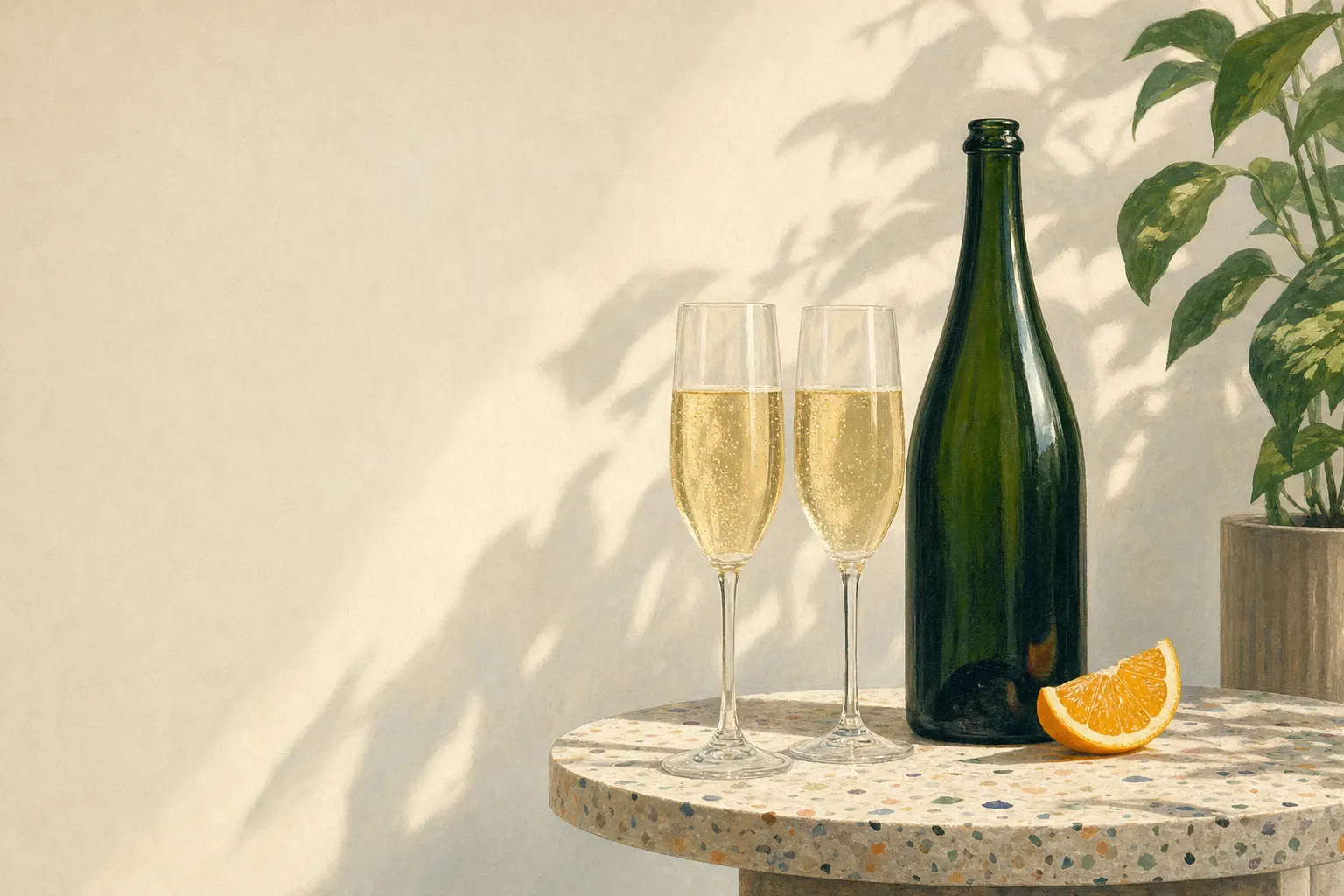
What is the alcohol percentage of champagne? Champagne is usually 12% to 12.5% ABV, and prosecco is about 11%. Cava is usually 11.5% to 13%, and sweet sparkling wines such as Moscato d'Asti are only about 5% to 7%. A 5 oz glass of 12% champagne is one US standard drink, and the same glass of 11% prosecco is about 0.9.
This guide compares the strength of sparkling wines, explains why champagne is stronger than prosecco, and works out mimosas, spritzes and full bottles. For UK units by bottle size, see units in a bottle of champagne.
Champagne and sparkling wine alcohol percentage chart
| Sparkling wine | Typical ABV | 5 oz glass (US standard drinks) | 125 ml glass (UK units) |
|---|---|---|---|
| Moscato d'Asti | 5%–6% | 0.5 (at 5.5%) | 0.7 |
| Asti Spumante | 7%–9.5% | 0.6 (at 7%) | 0.9 |
| Prosecco | 11%–11.5% | 0.9 (at 11%) | 1.4 |
| Cava | 11.5%–13% | 1.0 (at 11.5%) | 1.4 |
| Crémant | 11.5%–12% | 1.0 (at 12%) | 1.5 |
| English sparkling | about 12% | 1.0 (at 12%) | 1.5 |
| Champagne | 12%–12.5% | 1.0 (at 12%) | 1.5 |
Strength is printed on every bottle. These are typical ranges, so use your label for an exact figure. Still wines are compared in wine alcohol percentage by type.
Prosecco alcohol percentage
Most sparkling prosecco is 11% ABV. The Prosecco DOC rules set a minimum total strength of 11% for the fully sparkling (spumante) style and 10.5% for semi-sparkling (frizzante) and still prosecco. Sweetness terms are easy to misread: "Extra Dry" prosecco is sweeter than "Brut", but neither word tells you the alcohol percentage.
A 750 ml bottle of 11% prosecco holds about 4.6 US standard drinks or 8.3 UK units. For glass-by-glass UK figures, see units in a glass of prosecco.
Why is champagne stronger than prosecco?
- The second fermentation adds alcohol. Champagne is made by fermenting a still base wine again in the bottle, which adds roughly 1% to 1.5% ABV as well as the bubbles.
- Prosecco starts lighter. It is usually made in pressurised tanks from a lower-strength base, in a style that aims to stay fresh and light.
- Ripeness varies by year. Warmer vintages make more sugar in the grapes, and so more alcohol.
The gap is small. One 125 ml glass of 12% champagne has 1.5 units, and the same glass of 11% prosecco has about 1.4. How much is poured matters more than which bottle you choose.
How much alcohol is in a bottle of champagne?
| Bottle | 11% ABV (standard drinks) | 12% ABV (standard drinks) | 12.5% ABV (standard drinks) |
|---|---|---|---|
| 187 ml split | 1.2 | 1.3 | 1.3 |
| 375 ml half bottle | 2.3 | 2.5 | 2.6 |
| 750 ml bottle | 4.6 | 5.1 | 5.3 |
| 1.5 L magnum | 9.3 | 10.1 | 10.6 |
A 750 ml bottle pours about five 5 oz glasses or six 125 ml flutes.
Mimosa and spritz alcohol content
Mixing with juice lowers the percentage, but the total depends on how much wine is in the glass.
| Drink | Recipe used | Approximate ABV | US standard drinks | UK units |
|---|---|---|---|---|
| Mimosa | 75 ml champagne at 12% + 75 ml juice | 6% | 0.5 | 0.9 |
| Strong mimosa | 100 ml champagne at 12% + 50 ml juice | 8% | 0.7 | 1.2 |
| Bellini | 100 ml prosecco at 11% + 50 ml peach purée | 7.3% | 0.6 | 1.1 |
| Aperol spritz | 90 ml prosecco at 11% + 60 ml Aperol at 11% + 30 ml soda | 9.2% | 0.9 | 1.7 |
| Kir royale | 10 ml crème de cassis at 20% + 120 ml champagne at 12% | 12.6% | 0.9 | 1.6 |
Melting ice lowers the percentage over time, but not the total alcohol. Bottomless brunches are hard to count because the glass rarely empties before it is topped up.
The formula
US standard drinks = fluid ounces × ABV (as a decimal) ÷ 0.6
UK units = ml × ABV ÷ 1,000
Example 1: a 5 oz glass of 12% champagne
5 × 0.12 = 0.6 oz of pure alcohol, and 0.6 ÷ 0.6 = 1 standard drink
Example 2: a 125 ml glass of 11% prosecco
125 × 11 ÷ 1,000 = 1.375, or about 1.4 units
Example 3: a half-and-half mimosa of 150 ml
75 ml × 12% = 9 ml of pure alcohol. 9 ÷ 150 = 6% ABV, and 9 ÷ 10 = 0.9 units
Use the standard drink calculator or the alcohol units calculator for other glasses.
Is champagne stronger than wine or beer?
Champagne is about the same strength as a light to medium still wine, and lighter than many reds at 13.5% to 14.5%. It is more than twice as strong as a 5% beer by percentage, but the servings are smaller: a 5 oz glass of 12% champagne and a 12 oz can of 5% beer each contain one US standard drink.
Some small studies suggest carbonated drinks may be absorbed faster. That can change how quickly you feel the effects, but not how much alcohol you drink.
Count top-ups, not glasses
Finish one glass before refilling it, or note each top-up as its own entry. [Alcohol Tracker°](/) lets you record the pour and the ABV on iPhone or Apple Watch, so a toast, a mimosa and a half bottle all count correctly.
Never drive after drinking. A lower ABV or an estimated drink count cannot show that you are safe to drive, so arrange a sober driver, a taxi or public transport before a celebration.
Frequently Asked Questions
What percent alcohol is champagne?
Most champagne is 12% to 12.5% ABV. At 12%, a 5 oz glass is one US standard drink and a 125 ml flute is 1.5 UK units.
What percent alcohol is prosecco?
Sparkling prosecco is usually 11% ABV, and the Prosecco DOC minimum for the spumante style is also 11%. Semi-sparkling frizzante can be 10.5%.
Is champagne stronger than prosecco?
Usually by about one percentage point. A bottle of 12% champagne has 9 UK units, and an 11% prosecco has about 8.3.
How much alcohol is in a mimosa?
A half-and-half mimosa with 75 ml of 12% champagne is about 6% ABV and contains 0.9 UK units, or about half a US standard drink.
Does brut champagne have more alcohol?
Not necessarily. Brut describes low sugar, not alcohol. Brut and demi-sec champagnes are often bottled at a similar strength.
The quick answer
Champagne is usually 12% to 12.5% ABV, prosecco about 11%, cava 11.5% to 13%, and Moscato d'Asti 5% to 6%. A 5 oz glass of 12% champagne is one US standard drink, a 750 ml bottle is about 5, and a half-and-half mimosa is about 6%.
Sources: Prosecco DOC product specification (GOV.UK copy), NIAAA: What is a standard drink?, CDC: About standard drink sizes, NHS alcohol units, and the UK Chief Medical Officers' low-risk drinking guidelines.
Keep exploring
Use the calculator or continue with a related guide:
Put the guide into practice
Keep a clearer drink diary.
Track units, standard drinks, cost, calories, dry days and estimated BAC on iPhone and Apple Watch.