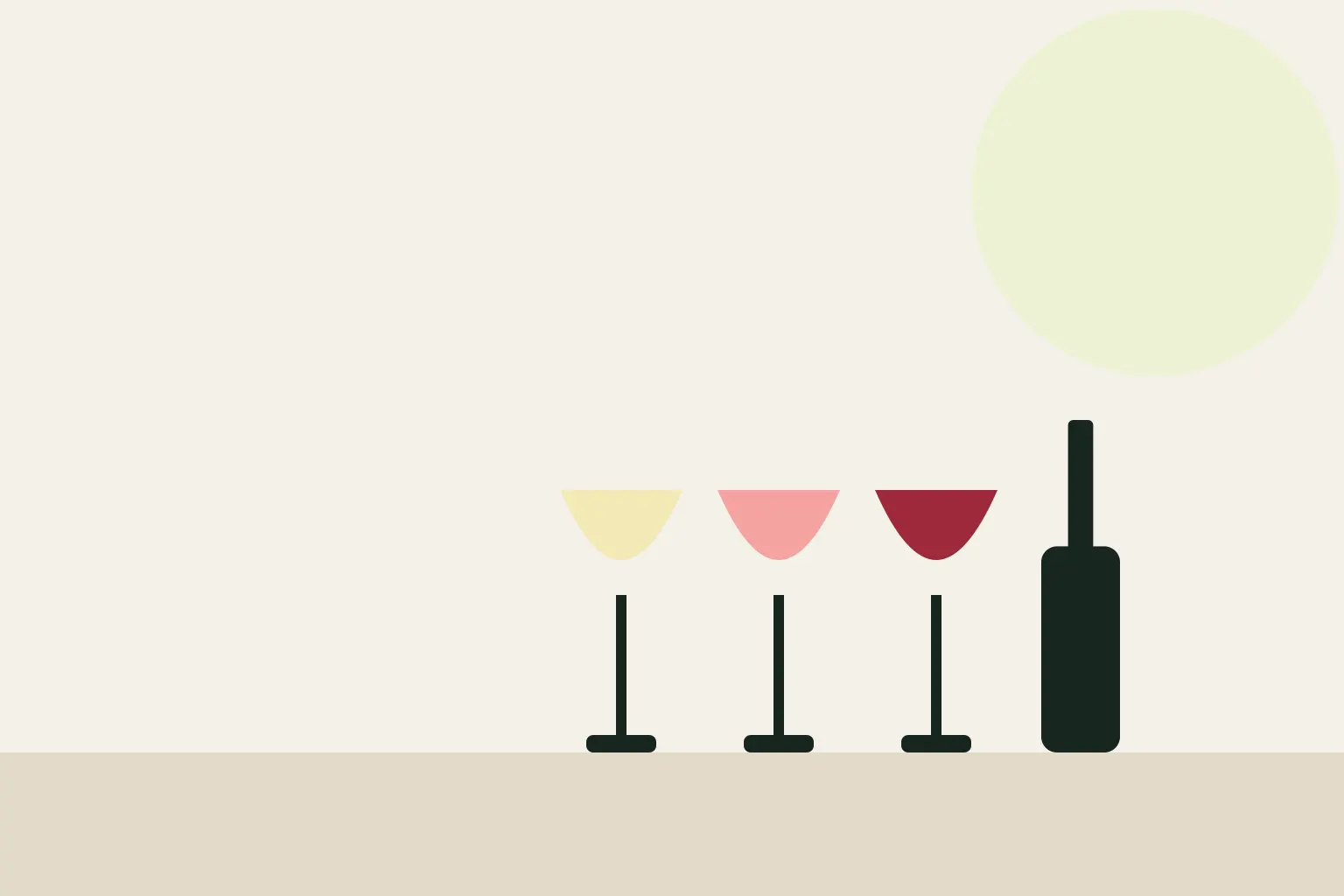
What is the alcohol percentage of wine? Most wine is 11% to 14.5% ABV, with an average of about 12% for white and rosé and 13.5% for red. Light styles such as Moscato d'Asti are about 5.5%, while ripe Zinfandel can reach 16% and fortified port is about 20%.
That spread matters more than it looks. A 175 ml glass of 14.5% Zinfandel contains 2.5 UK units, while the same glass of 8% Riesling contains 1.4. This guide lists typical strengths by wine type, explains why some wines are stronger, and shows how to turn ABV into units or standard drinks.
Wine alcohol percentage chart by type
| Wine | Typical ABV | UK units per 175 ml | US standard drinks per 5 oz |
|---|---|---|---|
| Moscato d'Asti | 5%–7% | 1.0 (at 5.5%) | 0.5 |
| German Riesling Kabinett | 7.5%–10% | 1.4 (at 8%) | 0.7 |
| Prosecco | 10.5%–11.5% | 1.9 (at 11%) | 0.9 |
| Pinot Grigio | 11.5%–13% | 2.1 (at 12%) | 1.0 |
| Champagne | 12%–12.5% | 2.1 (at 12%) | 1.0 |
| Rosé | 11%–13% | 2.1 (at 12%) | 1.0 |
| Sauvignon Blanc | 12.5%–13.5% | 2.3 (at 13%) | 1.1 |
| Chardonnay | 12.5%–14.5% | 2.4 (at 13.5%) | 1.1 |
| Pinot Noir | 12.5%–14.5% | 2.4 (at 13.5%) | 1.1 |
| Merlot | 13%–14.5% | 2.4 (at 13.5%) | 1.1 |
| Cabernet Sauvignon | 13.5%–14.5% | 2.5 (at 14%) | 1.2 |
| Shiraz or Syrah | 13.5%–15% | 2.5 (at 14.5%) | 1.2 |
| Zinfandel | 14%–16% | 2.6 (at 15%) | 1.3 |
| Sherry | 15%–22% | 3.0 (at 17%) | 1.4 |
| Port | 19%–22% | 3.5 (at 20%) | 1.7 |
These are typical ranges, not guarantees. The label on your bottle always wins. The US standard drink column uses a 5 oz glass; a standard drink is 0.6 oz of pure alcohol, so a 5 oz glass of 12% wine is exactly one.
How much alcohol is in red wine?
Red wine is usually 12.5% to 15% ABV, and a typical bottle is about 13.5%. Lighter reds such as Beaujolais and cool-climate Pinot Noir sit at the low end. Cabernet Sauvignon, Shiraz, Malbec, and Zinfandel from warm regions often sit at 14% or above.
At 13.5%, a 750 ml bottle of red holds 10.1 UK units or 5.7 US standard drinks. At 15%, it holds 11.3 units.
How much alcohol is in white wine?
White wine is usually 11% to 13.5% ABV, with about 12% as a common middle. Off-dry German Riesling and Moscato are much lighter, while oaked Chardonnay and Viognier from warm regions can reach 14% or more.
At 12%, a bottle of white holds 9 UK units or about 5 US standard drinks. A large 250 ml glass is 3 units.
Why are some wines stronger than others?
Alcohol comes from yeast turning grape sugar into ethanol. More sugar at harvest usually means more alcohol.
- Climate. Grapes grown in hot, sunny regions ripen with more sugar, so wines from California, Australia, and southern Spain tend to be stronger than those from Germany or northern France.
- Stopped fermentation. Moscato d'Asti and some Rieslings are stopped early, leaving sweetness and lower alcohol.
- Fortification. Port and sherry have grape spirit added, which lifts them to 15% to 22%.
How accurate is the ABV on a wine label?
Less precise than most people assume. Under US rules, a wine at 14% or below can differ from its label by up to 1.5 percentage points, and a wine above 14% by up to 1 point. A bottle labelled 13.5% could legally be anywhere from 12% to 14%. EU rules allow a smaller margin of 0.5 points. If you track closely, treat the label as an estimate.
How to turn wine ABV into units or standard drinks
UK units = ml × ABV ÷ 1,000
US standard drinks = fluid ounces × ABV (as a decimal) ÷ 0.6
Example 1: a 175 ml glass of 13% Sauvignon Blanc
175 × 13 ÷ 1,000 = 2.3 units
Example 2: a 6 oz pour of 14.5% Cabernet
6 × 0.145 = 0.87 oz of pure alcohol, and 0.87 ÷ 0.6 = 1.45 standard drinks
Example 3: a bottle of 5.5% Moscato d'Asti versus 15% Zinfandel
750 × 5.5 ÷ 1,000 = 4.1 units, and 750 × 15 ÷ 1,000 = 11.3 units. The Zinfandel has nearly three times the alcohol in the same bottle.
The alcohol units calculator and the standard drink calculator do these sums for any glass. For glass sizes, see how many ml are in a glass of wine, and for every drink type in one table, see the alcohol percentage chart for beer, wine and spirits.
Why wine strength is worth tracking
Two people can each drink "two glasses of red" and take in very different amounts of alcohol. Pour size and strength both rise together in many homes: a 250 ml glass of 14.5% wine is 3.6 units, while a 125 ml glass of 11% wine is 1.4.
If you log wine, log the ABV from the label rather than a default. [Alcohol Tracker°](/) lets you save the size and strength of the wines you usually drink on iPhone and Apple Watch, so each glass counts correctly.
Never drive after drinking wine. A wine's strength does not tell you when you are safe to drive; arrange another way home.
Frequently Asked Questions
What is the average alcohol percentage of wine?
Most table wine is between 11% and 14.5% ABV. White and rosé average about 12%, and red about 13.5%. Fortified wines such as port are about 20%.
Which wine has the lowest alcohol?
Moscato d'Asti, at about 5% to 7%, is one of the lowest. German Riesling Kabinett is often 7.5% to 10%. Alcohol-free and low-alcohol wines go lower still.
Which wine has the highest alcohol?
Among unfortified wines, Zinfandel, Amarone, and some Shiraz reach 15% to 16%. Fortified wines such as port, sherry, and Madeira are stronger, at about 15% to 22%.
Is 14% alcohol high for wine?
It is on the high side for table wine but common for warm-climate reds. A 175 ml glass at 14% contains 2.5 UK units, compared with 2.1 at 12%.
Is wine stronger than beer?
By percentage, yes. Wine is usually 11% to 14%, and most beer is 4% to 5%. Per serving the gap is smaller, because a 5 oz glass of 12% wine and a 12 oz beer at 5% are both one US standard drink.
The quick answer
Wine is usually 11% to 14.5% ABV: about 12% for white and rosé, 13.5% for red, 5.5% for Moscato d'Asti, up to 16% for Zinfandel, and about 20% for port. A 175 ml glass of 12% wine contains 2.1 UK units, and a 5 oz glass of 12% wine is one US standard drink.
Sources: eCFR: 27 CFR 4.36, alcohol content of wine, NIAAA: What is a standard drink?, CDC: About alcohol use, NHS alcohol units, and the UK Chief Medical Officers' low-risk drinking guidelines. Wine-style ranges are typical values from wine trade references.
Keep exploring
Use the calculator or continue with a related guide:
Put the guide into practice
Keep a clearer drink diary.
Track units, standard drinks, cost, calories, dry days and estimated BAC on iPhone and Apple Watch.