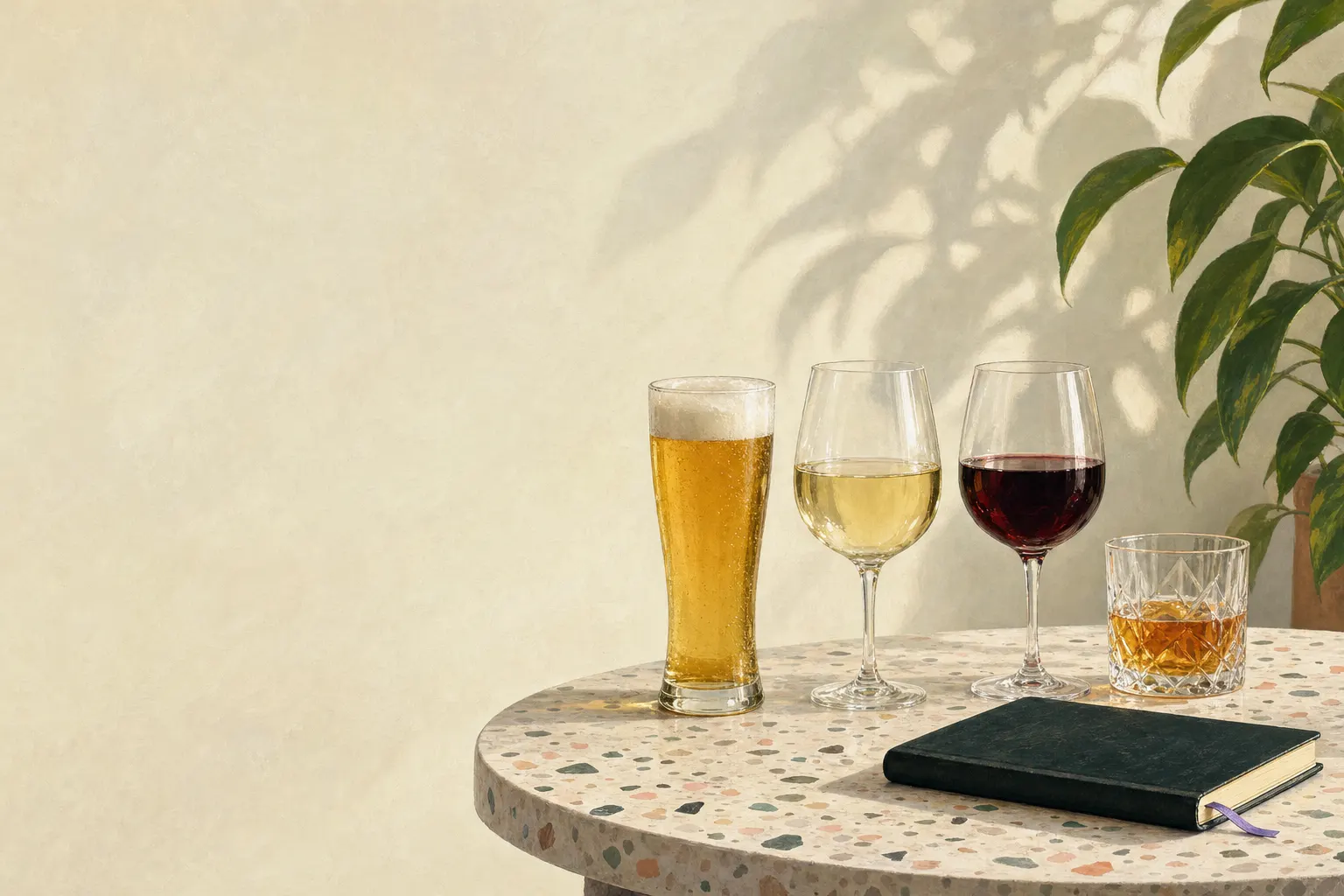
What is the alcohol percentage of common drinks? On average, beer is about 4% to 5% ABV, cider 4.5% to 5%, wine 12% to 14%, fortified wine 15% to 20%, and spirits 40%. US public health guidance uses 5% for regular beer, 12% for table wine, and 40% for distilled spirits when defining a standard drink.
ABV, or alcohol by volume, is the percentage of a drink that is pure alcohol. A 5% beer is 5% alcohol, so a 500 ml can contains 25 ml of pure alcohol. ABV matters because serving sizes hide big differences: a pint of 6.5% IPA contains more alcohol than a large glass of 11% wine. This guide gives typical ABVs for every common drink type and shows how to turn them into units or standard drinks.
Average ABV chart: beer, wine, spirits and more
| Drink | Typical ABV range | Common reference ABV |
|---|---|---|
| Alcohol-free beer (UK) | up to 0.05% | 0.05% |
| Low-alcohol beer (UK) | up to 1.2% | 0.5%–1.2% |
| Light beer (US) | 3.5%–4.2% | 4.2% |
| Lager | 4%–5% | 4.5% |
| Bitter or ale | 3.5%–4.5% | 4% |
| Stout | 4%–5% | 4.2% |
| IPA | 5.5%–7.5% | 6.5% |
| Double IPA or strong ale | 8%–10% | 8% |
| Malt liquor (US) | 6%–8% | 7% |
| Cider | 4%–7.5% | 4.5%–5% |
| Hard seltzer | 4%–5% | 5% |
| Prosecco | 10.5%–11.5% | 11% |
| White wine | 11%–13.5% | 12% |
| Rosé | 11%–13% | 12% |
| Champagne | 12%–12.5% | 12% |
| Red wine | 12.5%–14.5% | 13.5% |
| Sake | 14%–16% | 15% |
| Sherry | 15%–22% | 17.5% |
| Port | 19%–22% | 20% |
| Liqueurs (cream and fruit) | 15%–30% | 17%–20% |
| Vodka, gin, rum, whisky | 37.5%–40% | 40% |
| Cask-strength whisky | 50%–65% | 55% |
Product labels always override these ranges. Craft beers, natural wines, and imported spirits often sit outside the typical band.
How much alcohol is in beer?
Most UK lagers are 4% to 5%, and most US regular beers are about 5%. Strength varies far more than serving size suggests:
- Session beers at 3.5% to 4% contain roughly 2 units per pint.
- Premium lagers at 5% contain 2.8 units per pint.
- IPAs at 6.5% contain 3.7 units per pint, and a double IPA at 8% contains 4.5.
For can and pint charts, see how many units are in a pint and how many units are in a can of beer.
What is the alcohol percentage of wine?
Table wine is typically 11% to 14.5% ABV. Grapes from warmer climates ripen with more sugar, which ferments into more alcohol, so many reds from hot regions are 14% or higher, while light whites and German Rieslings can be 8% to 11%.
| Wine | Typical ABV | UK units per 175 ml | UK units per 750 ml |
|---|---|---|---|
| Light white | 11% | 1.9 | 8.3 |
| Average white or rosé | 12% | 2.1 | 9.0 |
| Average red | 13.5% | 2.4 | 10.1 |
| Full-bodied red | 14.5% | 2.5 | 10.9 |
| Port | 20% | 3.5 | 15.0 |
A "normal" red wine is about 13% to 14% ABV. That is why a bottle of red often contains around 10 UK units rather than the 9 units in a 12% white. For glass sizes, see how many ml are in a glass of wine.
Spirits and liqueurs
Most spirits are bottled at 37.5% to 40% ABV. In the UK and EU, vodka, gin, and rum must be at least 37.5%, and whisky at least 40%. Liqueurs range from about 15% (cream liqueurs) to 40% or more (some herbal liqueurs). Because spirits are so concentrated, a 25 ml measure at 40% contains exactly 1 UK unit.
How to turn ABV into units or standard drinks
UK units = volume in ml × ABV ÷ 1,000
US standard drinks = fluid ounces × ABV (as a decimal) ÷ 0.6
Example 1: a pint (568 ml) of 6.5% IPA
568 × 6.5 ÷ 1,000 = 3.69, or about 3.7 UK units
Example 2: a 12 oz can of 7% malt liquor
12 × 0.07 = 0.84 oz of alcohol, and 0.84 ÷ 0.6 = 1.4 standard drinks
Example 3: a 175 ml glass of 14.5% red wine
175 × 14.5 ÷ 1,000 = 2.54, or about 2.5 UK units
The alcohol units calculator and the standard drink calculator handle any combination of size and ABV. For a full set of worked servings, the alcohol units chart is a quick reference.
Why ABV matters more than drink type
The same "one drink" can contain very different amounts of alcohol:
| Serving | ABV | UK units | US standard drinks |
|---|---|---|---|
| 12 oz (355 ml) regular beer | 5% | 1.8 | 1.0 |
| Pint (568 ml) IPA | 6.5% | 3.7 | 2.1 |
| 5 oz (148 ml) white wine | 12% | 1.8 | 1.0 |
| 250 ml red wine | 14% | 3.5 | 2.0 |
| 25 ml spirit | 40% | 1.0 | 0.6 |
| 1.5 oz (44 ml) spirit | 40% | 1.8 | 1.0 |
ABV and units describe how much alcohol is in a drink. They do not tell you how impaired you are, how quickly alcohol will clear, or whether you can drive. Never use an ABV or units calculation to decide whether it is safe to drive.
Track drinks by ABV, not by type
Logging "a beer" or "a glass of wine" hides the differences above. Recording the size and ABV from the label gives a much more accurate weekly total. Alcohol Tracker° lets you log drinks with their volume and ABV and keeps your weekly units total. You can [see Alcohol Tracker° for iPhone and Apple Watch](/) if you want an easier way to track.
Frequently Asked Questions
What is the average alcohol percentage of beer?
Most regular beer is about 4% to 5% ABV. US guidance uses 5% for a standard 12 oz beer. Craft IPAs are commonly 6% to 7.5%.
What is the normal alcohol percentage of red wine?
Most red wine is 12.5% to 14.5% ABV, with 13.5% a common average. Reds from warm climates are often 14% or more.
How much alcohol is in an IPA?
Most IPAs are 5.5% to 7.5% ABV. A pint at 6.5% contains about 3.7 UK units, and a 12 oz can at 7% is about 1.4 US standard drinks.
What percentage of alcohol is in spirits?
Most spirits are 37.5% to 40% ABV. UK and EU rules require at least 37.5% for vodka, gin, and rum, and at least 40% for whisky.
Is 5% ABV strong for beer?
5% is a standard strength for lager and most US beer. Beers at 6% or more are considered strong, and 8% or more is very strong.
The quick answer
What is the alcohol percentage of beer, wine, and spirits? Beer is usually 4% to 5% ABV, cider 4.5% to 5%, wine 12% to 14%, fortified wine 15% to 20%, and spirits 37.5% to 40%. Multiply millilitres by ABV and divide by 1,000 to get UK units for any drink.
Sources: NIAAA: What is a standard drink?, CDC: About standard drink sizes, Dietary Guidelines for Americans, NHS alcohol units, and EU spirit drinks regulation 2019/787.
Keep exploring
Use the calculator or continue with a related guide:
Put the guide into practice
Keep a clearer drink diary.
Track units, standard drinks, cost, calories, dry days and estimated BAC on iPhone and Apple Watch.